






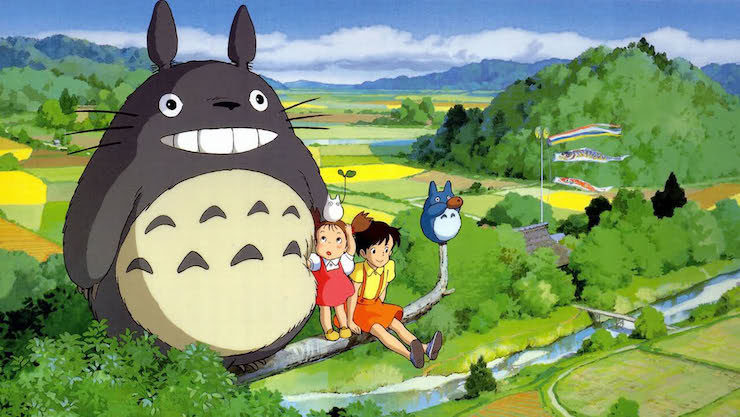
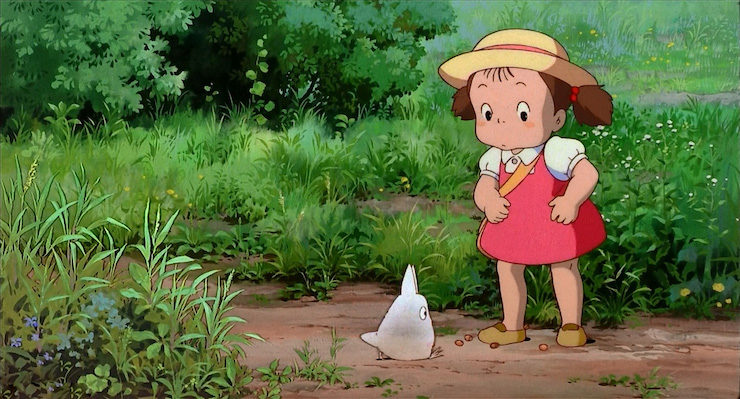
There’s a moment in Hayao Miyazaki’s film My Neighbor Totoro that’s stuck with me since I first watched it a decade ago. Satsuki Kusakabe is searching for her missing sister, Mei. Looking for help, she sprints towards the huge camphor tree where the magical creature Totoro lives. She pauses for a moment at the entrance to a Shinto shrine that houses Totoro’s tree, as if considering praying there for Totoro’s help. But then she runs back to her house and finds her way to Totoro’s abode through the tunnel of bushes where Mei first encountered him. Totoro summons the Catbus, which whisks Satsuki away to where Mei is sitting, beside a lonely country road lined with small statues of Jizo, the patron bodhisattva of children.
It’s Satsuki’s hesitation in front of the shrine’s entrance that sticks with me, and what it says about the nature of spirits and religion in the film. We don’t really think of the movies of Hayao Miyazaki as religious or even spiritual, despite their abundant magic, but some of his most famous works are full of Shinto and Buddhist iconography—like those Jizo statues, or the sacred Shimenawa ropes shown tied around Totoro’s tree and marking off the river god’s bath in Spirited Away. Miyazaki is no evangelist: the gods and spirits in his movies don’t follow or abide by the rituals of religion. But the relationship between humans and gods remains paramount.
Miyazaki’s gods and spirits aren’t explicitly based on any recognizable Japanese “kami” (a word that designates a range of supernatural beings, from the sun goddess Amaterasu to the minor spirits of sacred rocks and trees). In fact, whether Totoro is a Shinto spirit or not is a mystery. He lives in a sacred tree on the grounds of a Shinto shrine. The girls’ father even takes them there to thank Totoro for watching over Mei early in the film. But Satsuki calls Totoro an “obake,” a word usually translated as “ghost” or “monster.” Miyazaki himself has insisted that Totoro is a woodland creature who eats acorns. Is he a Shinto spirit? A monster? An animal? A figment of the girls’ imaginations? The film—delightfully—not only doesn’t answer the question, it doesn’t particularly care to even ask it.
It’s a refreshing contrast to many American children’s movies, where bringing skeptical adults around to believing in some supernatural entity is often the hinge of the plot. The adults in Miyazaki’s movies either know the spirits are real (Princess Mononoke) or don’t question their children when they tell them fantastical stories (Totoro and Ponyo). The only adults who express doubts are Chihiro’s parents in Spirited Away, and they get turned into pigs. Believe in the spirits or not; they abide.
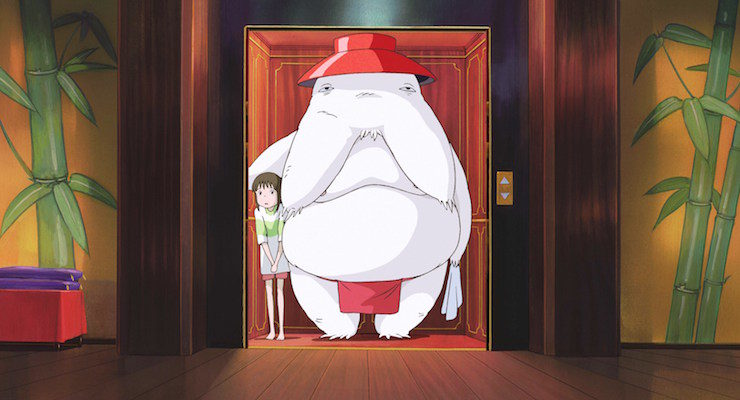
A lot of them abide in, or at least patronize, Yubaba’s bathhouse in Spirited Away. Many of the kami that appear in Spirited Away are wonderfully strange, like huge chicks and a giant radish spirit. But a few resemble traditional Japanese gods, like Haku and the “stink spirit,” who are both river dragons (unlike their fiery Western counterparts, Japanese dragons are typically associated with water). Both have been deeply injured by humans: Haku’s river has been filled in and paved over to make way for apartment buildings; the “stink spirit” is polluted with human garbage and waste, from a fishing line to an old bicycle. The gods seem more vulnerable to the whims of humans than the other way around. No wonder Lin and the other bathhouse workers are so terrified of Chihiro when they discover she’s human.
The tension between humans and spirits escalates into full-out war in Princess Mononoke, in which Lady Eboshi battles against the gods of the forest so that she can expand her iron-mining operation. Mononoke’s kami are woodland creatures: wolves, wild boars, and deer. They’re just as fuzzy as Totoro, but a lot less cuddly. Like the wilderness itself, they are elemental, powerful, dangerous, and sources of life and death. But they are also vulnerable. Mankind’s pollution and violence can corrupt nature and the spirits—one of Eboshi’s bullets turns a wild boar-god into a rampaging demon—but that damage rebounds back on mankind, particularly affecting the most vulnerable among us (much the same way poor nations and communities are currently bearing the brunt of climate change). It’s not Eboshi who ends up cursed by the boar-demon, after all; it’s Ashitaka, a member of the indigenous Emishi people. And when Eboshi manages to kill the Great Forest Spirit with her gun at the film’s climax, it sends a literal flood of death over the entire landscape.
Miyazaki doesn’t paint in black and white, though. Lady Eboshi may be a god-killer, but she’s also enormously sympathetic and even admirable. She’s a woman who’s carved out a seat of power in feudal Japan, and she uses that power to give shelter and jobs to marginalized members of society, including lepers, prostitutes, and Ashitaka himself. If deforestation and industrialization put mankind in conflict with the environment and even the gods, it can also be the only opportunity for the poor and outcast to survive. The only real villains in Mononoke are the local samurai—portrayed as violent goons—and Jikobo, a Buddhist monk in the Emperor’s service looking to collect the Great Forest Spirit’s head. The Emperor wants the godhead because possessing it will supposedly grant immortality.
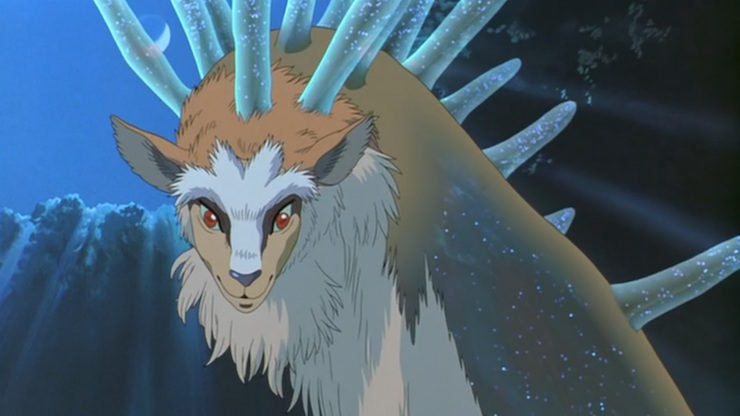
The unnamed Emperor’s desire for a god’s severed head is a perversion of Japanese religious ritual. Rather than making offerings to them and beseeching the gods for favor for his people, this fictional Emperor wants to murder a god to gain eternal life for himself. It’s a small but fairly radical plot point, given that in the era the film takes place, the Emperor was himself considered a kami and a direct descendant of the sun goddess. Miyazaki isn’t indicting the Chrysanthemum Throne, though, but rather the selfish lust for personal gain by the powerful. Gods can be corrupted into curse-bearing demons, and so can those—like the monk Jikobo and the Emperor—who are supposed to serve as their intermediaries.
But while the relationships between kami and humans can be fraught and even lethal, they can also be intimate and positive. Satsuki and Mei give Totoro an umbrella and he gives them a bundle of seeds. The wolf goddess Moro raises San as her own child, and when she grows up, San fights for the forest against Eboshi. Haku rescues toddler-Chihiro from drowning, and she in turn risks her life to save his and free him from Yubaba’s service.
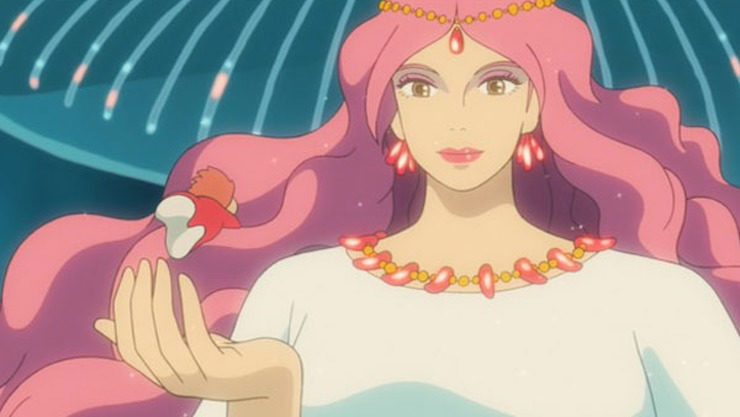
That intimacy is most apparent in Ponyo, about the love between a little boy named Sosuke and a goldfish who turns herself into a girl thanks to a drop of Sosuke’s blood and some powerful magical potions. While set in Japan like Totoro, Spirited Away, and Princess Mononoke, Ponyo’s supernatural world is a mythological melange. Ponyo is based on Hans Christian Andersen’s The Little Mermaid, but it also echoes the Japanese folktale of Urashima Taro, about a young fisherman who rescues a sea turtle and is rewarded with a visit to the undersea palace of the kami Otohime. Ponyo’s birth name is Brunhilde, a nod to the Valkyrie daughter of Wotan in the Germanic Nibelungenlied. And her mother is Gran Mamare, a sea goddess with a Latinish name, but who one Japanese sailor calls Kannon, the Buddhist goddess of mercy. More than anything, she seems to be the ocean itself, ancient and immeasurably powerful. Our religious myths and folktales, Ponyo suggests, are mere approximations for the true nature of the earth and its spirits.
In all Miyazaki’s movies, it’s children who best grasp that nature. Sosuke and Ponyo love each other; so do Chihiro and Haku. No adult ever even sees Totoro or the Catbus, though they may feel their presence in the lilt of strange music on the air or a gust of wind (this may even extend to viewers; I’d seen Totoro countless times, but it was my 3-year-old son Liam who pointed out to me that the gust of wind that blows the firewood out of Satsuki’s hands near the beginning of the film is likely the invisible Catbus running by).
It’s not that children are pure and innocent and unquestioning—Miyazaki’s young protagonists are thoroughly human and flawed. It’s that they’re open to the spirits in ways adults are not. They don’t mediate their experience of nature and the world through the rituals of religion or calcified worldviews. Mr. Kusakabe may need to visit the camphor tree shrine to speak to Totoro, but Satsuki and Mei don’t—they can find their way to him from their own yard. Adults see what they expect to see. Children have few expectations for what is and isn’t lurking out there in the world; they’re the ones who glimpse shadows moving in the gloom of an abandoned amusement park, a goldfish returned in the shape of a girl, or a small white spirit walking through the grass.
Miyazaki’s films don’t invite us to any particular faith or even belief in the supernatural, but they do invite us to see the unexpected, and to respect the spirits of trees and woods, rivers and seas. Like Totoro and Gran Mamare, their true nature and reasoning are beyond our comprehension. Call them kami, or gods, or spirits, or woodland creatures, or Mother Nature, or the environment. They are there if we know where to look, and their gifts for us are ready if we know how to ask. We have only to approach them as a child would—like Satsuki, Mei, Chihiro, and Sosuke—with open eyes and open hearts.
Austin Gilkeson formerly served as The Toast‘s Tolkien Correspondent, and his writing has also appeared at Catapult and Cast of Wonders. He lives outside Chicago with his wife and son.

What a lovely and insightful piece!!!! I really enjoyed this analysis (especially the bit where Liam notices the gust of wind as probably the catbus!)
It’s only Westerners who would ask “Is it a supernatural being or a living animal?” as if those were mutually exclusive categories. Non-Western belief systems often don’t draw any distinction between the natural and supernatural, seeing them as facets of the same thing. In Shintoism, every physical object or being contains a supernatural spirit. Which is why there are so many anime or tokusatsu shows depicting things that are both technological and spiritual at the same time — like in Serial Experiments Lain, where the Internet basically becomes a god, or in the Digimon franchise, where online game monsters become imbued with soul and have their own mystical world existing in cyberspace. Or in Super Sentai (the basis of Power Rangers), where the giant robots the Rangers pilot are often portrayed as living beings, magic spirits, or literal deities in their own right.
So is Totoro a woodland animal or a mystical spirit? Yes.
@2
This is an interesting point and I could see how it might be relevant to a couple Miyazaki movies not mentioned in this post: Nausicaa of the Valley of the Wind, and Laputa, Castle in the Sky. Both feature more technological themes (giant robots, ancient power sources) but these elements still function as spirit-like or magical. Even as they are explained in secular terms, they maintain a sense of magic or wonder; the Ohms of Nausicaa for example, which I would argue become more spiritually charged after their ecological origins are revealed.
@3 Not entirely absent from movies that aren’t Miyazaki or Japanese. For example, Wall-E has robots whose power seems at least partly spiritual.
So does The Iron Giant. And the Transformers series. And Batteries Not Included. And The Day the Earth Stood Still. And probably a lot of ones I didn’t happen to think of. Each in a different way, and probably all different from how Miyazaki movies would do, but I think it’s worth thinking about.
I too found this to be a lovely article. I’ve been an avid fan of Miyazaki’s since I took my daughter to see Spirited Away when it was first released in the States back in the day :). Thank you.
Great essay. These films really have a wonderful array of inhuman beings and their diverse interactions with humans.
Watching Totoro as a kid, I was very upset by the unfairness of the fact that adults couldn’t see the creatures. If you weren’t lucky enough to encounter them as a child, you never would, even if you later lived among them. I feared adulthood and the losses it would bring me, and this seemed like one of them.
@4/Leah: I don’t see anything spiritual or mystical about Gort in TDTESS. He’s explicitly just a sentient robot. If you’re referring to his “resurrection” of Klaatu, that’s explained as the result of advanced technology (both in the movie and in the story it’s based on, though the story’s version is dumber).
As for the other examples, I’d call those more anthropomorphic than supernatural. They treat AIs as if they have humanity, what some might call a “soul,” and in the case of Transformers, their “sparks” are treated as the equivalent of a soul, at least in their own beliefs. But that’s still thinking in Western terms, that a soul is some intangible extra quality that certain physical beings are imbued with. I’m talking about something very different, the non-Western idea that a living animal or even a nonliving mechanism can literally be a god or other supernatural being in its own right, that there is no distinction at all between the natural and the divine.
@2/7: I’m not Japanese so I didn’t want to get too deeply into Shinto/Buddhist conceptions of godhood, but you’re absolutely right that living/mortal godhood (like Totoro’s kusunoki!) is very much a part of the Japanese spiritual tradition, and is what Miyazaki is drawing on. I can’t speak for Miyazaki’s personal beliefs, but what I tried to get across in the essay is exactly that: that the spirit world and natural world are one and the same. Moro, Nago, and the other kami in Mononoke-hime very much embody this: they are woodland animals AND gods. I think Totoro is a slightly different beast, because Miyazaki makes his nature more ambivalent–hence his not resembling any known animal *or* kami or obake/yokai/mononoke, and that brief moment of Satsuki hesitating at the shrine’s entrance.
As a scientist and an armchair philosopher I have always found the lack of distinction between nature/technology and divinity in Anime to be amazingly interesting. One of my first real examples of this was in reading the manga version of ghost in the shell – the manga author had extensive notes about the technology involved but only very brief ones about the various technology having souls and used phrases like “as we all know…”. I found this fascinating (and it was also my first example of the differences between translation and localization and led to my love for translation over localization as I dived into a much deeper love/study of shintoism because of this). Lain is perhaps one of my favorite anime (next to Hanibai Renmei which I would REALLY love to see someone here tackle the very interesting mix of western and eastern religious symbolism and philosophy in that work – I have considered trying myself but I don’t know nearly enough to do so really) for how it tackles this.
I do want to take one beef with the article a little bit though as I really have never seen Miasakyai’s children as flawed. He seems to portray them as pretty flawless tabula rasas to me (one of my issues with him) but I may have a different idea of flawed as I never saw the samuria or even the Emperor or his flunky as “flawed/evil”. In fact the complete lack of what I would call a villain in Princess Mononoke was one of my favorite parts about it. I certainly didn’t see any flaws in the children in Ponyo either. I have not seen spirited away…and I couldn’t survive seeing grave of the fireflys so this could change my perception I don’t know. One of the things that made it Monokoe so much better than any Western children’s shows was the lack of a simple good and evil. We do a disservice to our children in the west I think by hiding the grayness of the world from them I think.
Nothing in life is simple.
@9 – Miyazaki’s heroes and heroines are usually flawed, though not in melodramatic, grim ‘n gritty fashion as heroes often are in American entertainment. Satsuki loses patience with Mei; Chihiro is obstinate and scared at first; San is violent; Ponyo’s impulsiveness causes a tsunami. It’s true they often lack hard character arcs (Chihiro is an exception) but to me that makes them more realistic and human. Miyazaki could have played up the tension between Satsuki and Mei and had them learn valuable lessons about each other, but he doesn’t. Their relationship feels much more lived-in and real than siblings in most American movies, where the emphasis is often on bickering and learning to appreciate difference. The Kusakabe girls may lack meaningful character arcs, but that also means they don’t slot easily into archetypes. They feel like real children to me, rather than characters.
@10/Austin: I wholeheartedly agree that the girls in Totoro feel like real children. It’s one of the things I love most about the film.
The thing is we forget that western culture/philosophies is very much based on dichotomies right/wrong, good/evil whereas the eastern philosophies seem to be much more flexible on degrees of whatever
Take the Yin/Yang symbol for example yin has a bit of yang and yang has a bit of yin and they both curl around each other to form the whole always fascinates me how deep that symbol/idea really is.
@12 yes this is why I find eastern philosophy so very interesting. Good always has a little bit of evil evil always has a little bit of good. It was looking before the director change that the next star wars movie was going to explore this. Now I doubt it will.
@10 yeah as I thought you were using a different definition of flawed than I was. I mean I wouldn’t call that flawed so much as normal. Saying a character is flawed brings to mind tragic Shakespearean character flaws to me. I mean I never expected my heroes to be perfect fairy tale paragons of virtue since I was nine (I mean even good childrens literature like C.S. Lewis didn’t portray them this way. Aslan was certainly not perfect or perfectly understandable).
So no one wants to take on Hanabai Renmei? Sigh – such a great show that I wish more people knew about.
@13 dwcole but having a flaw (hamartia) in that way is just a story telling convention. It doesn’t do anything to make characters more or less realistic and believable to me.
Back to the subject of this post… I think Nausicaa is a great example of the blurring of natural and spirit. I am still not sure where I stand on whether the ohmu are simply and only animals/creatures, or whether there is also a supernatural and spirit component to them as well. And there is definitely a sense of the entire ecosystem as a single spiritual entity.
@13, Now I see what you mean! And “normal” is such a good description of Miyazaki’s protagonists, in a good way (for me at least).
@14, I thought about including Nausicaa because it definitely deals with similar themes (especially with Mononoke) and has a spiritual aspect to it (the Ohmu, Nausicaa as the Chosen One, etc.) and roots in Japanese folklore (“The Princess Who Loved Insects”), but I decided to focus on the movies set in Japan and with explicit Shinto/Buddhist references, since I think they do interesting things with the relations between kami, religion, and humans.
It’s called 灰羽連盟 haibane renmei.
@16 Thanks! I can never get the spelling for that one right – and yes that i the one would love to have someone discuss it. Went to an odd anime conference/fanzine schoolgirls and mobilesuits when the creator was there and it was incredibly interesting. Some great discussion of the show and I’ve been looking for similar deep discussion of it since.
@15 yes – comes back to I don’t expect my “heroes” to be superman levels of perfect all the time – and is why when people tell me things like “Martin Luther King had affairs” I am like so, still heroic. Glad to see we are on the same page. So often I am not on the same page as posters here…